27 July 2010

Crocodile feeding

Psa. 147.9 He gives to the beast its food


Let's see if I can put these stills into order. My wife and I were in Darwin, at Crocodylus Park, and the tour guide gave her the rod, like a fishing rod, to which he tied the chicken on the end, and she got to feed the 5 metre long croc. Too cool.

Feeding animals reminds me of the care that all the zookeepers and others who work at the park have for all the animals. I put a lot of the photos of the animals on my Flickr site. Emus and ostriches, tiger and lions, monkeys, you get it. The dingo was so domesticated that he preferred a tummy rub by the zookeep to a chase in the wild.

Even though there are 10,000 crocodiles in the park, and most are raised for products like belts and boots and handbags, I enjoyed being there and seeing them. They are ferocious though, and warnings abound about extending your body over the wrong edge.

Each croc can jump high out of the water. Amazing creatures. They can run at 30 kph, and dart out of the water to consume photogs and others standing on the side of a pond or creek. I was glad for the cage. I like safety.

So there you have it, I like safety and I like animals. And the zookeepers at Crocodylus Park and the rangers have great care for the animals.

When I listened to them, I wondered, what does this say about mankind and about God? I suppose as a demonstration of the love He has for us all, He tells us to tend the garden, keep it, subdue the earth, make it a good place. God made the animals on the last day, the same day as He made man. When man ruined the world, and God had to punish the world, He made sure that animals would abound on the other side of the deluvian world as He told Noah to take animals onto the ark. (Psalm 36.6)

He wanted man to regard species in their place, hence no bestiality (Lev. 18.23), and if someone wrongly killed an animal, he was fiscally responsible. (Lev. 24.18).
Giving drink to a thirsty animal is praised (Psalm 104.11)

My favorite is
"A righteous man has regard for the life of his beast, But the compassion of the wicked is cruel." (Proverbs 12.10)

If God so loved the world, and that includes you, loved you so much that He sent Y'shua to die for you and give you eternal life, ought you not also have compassion on others, share love and life? And if that means your neighbour's dog or your friend's budgee, great. A bit of kindness goes a long way, amen?

23 July 2010

1 in 14 on FB


Is it true, is it really true that one of 14 people in the world is registered and is using Facebook? That would include all the poor people who don't even have electricity, those in Haiti, who lost so much, those in old folks' homes who are happy when someone brings either a book or a face to them, and everyone in between. Is it really true, 1 in 14?

So reported RTE Travel yesterday (http://www.rte.ie/business/2010/0722/facebook.html) that Facebook has now registered 500 million users, which would mean 1 in 14.

'The number of people using Facebook has hit the 500 million mark, meaning one in every 14 people on the planet has now signed up to the online social-networking service. As of this morning, 500 million people all around the world are actively using Facebook to stay connected with their friends and the people around them,' founder Mark Zuckerberg said in a blog post. To celebrate, the California firm introduced an application that lets members of the online community 'tell the incredible stories of the moving and interesting ways they've used Facebook'.

Of course, some may have multiple accounts, like we do. JewsforJesus AustralAsia and Bob Mendelsohn are both me. OK< so maybe there will be some like me, but still one in 20 is an awesome number to imagine. 5% to 7% of the world looking at the same silly photos and updates and conversations and YouTube data,... all uploaded to Facebook in nanoseconds of one another.

Community. Isn't that what this 'social utility' is? The RTE site said, "Examples given by Zuckerberg included NATO Secretary General Anders Fogh Rasmussen jogging with Facebook fans during his term as Danish prime minister and a US woman using the service to battle breast cancer."

People are looking for social networking. They are looking for a social utility. Honestly, they are looking for relationships. I heard a woman on TV yesterday who said that although all her friends are on FB, she is not. It sounded like she had an active life, an active social life, and as such, I admire and applaud her. She doesn't need a virtual life when she has a real one.

Maybe that's why so many are joining. They don't have a real life. (Please, don't misread me, if you are on FB, I'm not saying you have no real life. Otherwise I twice condemn myself) But people are longing for community. They want connection. We want to be known and loved and get updates from people who show pictures of people we know or knew. Especially people we knew 'back in the day' when we knew them last. When we experienced community with them. When we were in school together or in the army or in the first job or... when life was real, not virtual.

Jeremy Brent and Alison Gilchrist studied for their Ph D at Bristol at the same time. She writes about Jeremy's latest book, Searching for community: representation, power and action on an urban estate, based on his Ph. D. dissertation, "He is critical of romantic, homogeneous notions of community, and talks knowledgeably about the complex dynamics of community politics and passions. Like me, he is interested in the networks of relationships that form the ecology of local life and at one point he writes: “the more connections, the more exciting the territory” (p145). Even at its most challenging, Jeremy clearly relished his long-term ‘inside-outsider’ role, illustrating this through a bricolage of anecdote and diary notes, that describe critical episodes and accounts of his work to support different community initiatives.

The book is based on his PhD thesis and as such can be heavy-going in places, ...and his commitment to the young people and the people of Southmead is clear throughout. His untimely death in 2006 has been a loss to us all."

So some sociologists agree that community is what we want. What life do you want? Will it be virtual or real? Will it be a connection electronically to those with whom you continue to share good life, or will it be a wishful dream, vanishing as quickly as yesterday's updates? Or maybe you don't even have time for this blog, as you are full in adventure, full in society where you live. If so, goodonya, matey. Enjoy the day. There are 13 out of 14 who are not on Facebook, 93% of the world. So maybe we 7%ers are way off base.

Either way, in real or virtual life, enjoy the day. Enjoy the Lord of All Days, Lord of Eternity, the God of Abraham, Isaac, and Jacob. He sent His only Son to the world so we could have eternal life, abundant, rich, electronic and real.

21 July 2010

Even Gold Coast Girls read our flyers

The week in Brisbane was marked with fellowship meetings and outreach events in the Gold Coast and throughout Brisbane. Churches welcomed us to preach on Sunday, we conducted a Jewish evangelism seminar and a pastors' breakfast, but for some reason, this photo has gotten the most notice of all we did. That is, on the Flickr site where all our photos are, the radio interviews, the advertisement, the Shabbat gathering...everything we did in a week, including some fun and rest at Noosa on Saturday... nothing has gotten the hits as much as these Meter Maids at Surfers Paradise.

Go figure.

The meter maids are receiving and reading our Gospel tract that we distributed at the University of Queensland, at the CBD in Brisbane and here in Surfers.

Our question to them was "Who do you think Jesus is?" Our question to you is..."who do you think Jesus is?"

20 July 2010

Competition


competition..
Originally uploaded by Sir Mervs
I'm writing from the Brisbane Airport at the end of a week-long effort of evangelism, recruitment, public relations, fun, and discipleship. And at the end, I think I've seen a dark side of something to which I've always given myself. It's something which is so deep in the craw of most people, that if I title it "a sin", or even error or wrong in the slightest, I will incur wrath from many, no doubt. And if that is so, for that wrath I apologize if for any undue reason I cause it.

However, if you can see what I saw, if you can see what God wants out of our relationships, if for any reason this makes sense to you, I hope that you will write/comment me.

This swimming photo is one I found on Flickr; I did not take this photo. But it's so innocent. It's a race, one with a youngster learning to keep her head in the water and her arms extended. And her family, no doubt, was cheering and enthusiastic and maybe even proud of her, if only for getting into the water.

This week in Brisbane I saw an unhealthy competition, in fact, what I could title "the spirit of competition." I've seen some references to the word "competition" in the Bible; here are a few verses of proximate thinking:

Jer. 12.5 ¶ “If you have run with footmen and they have tired you out, Then how can you compete with horses? If you fall down in a land of peace, How will you do in the thicket of the Jordan?
Jer. 22.15 “Do you become a king because you are competing in cedar? Did not your father eat and drink, And do justice and righteousness? Then it was well with him.
1Cor. 9.25 And everyone who competes in the games exercises self-control in all things. They then do it to receive a perishable wreath, but we an imperishable.
2Tim. 2.5 And also if anyone competes as an athlete, he does not win the prize unless he competes according to the rules.

But what I saw in Brisbane was not healthy; it was downright hostile. And sadly it happened in the Jewish believing community as well as the rest of the church. My conclusion is not the result of an exhaustive survey, but rather the continuous and haunting thought which has prompted my praying all week.

We conducted a Shabbat gathering at our rental house in Kangaroo Point. Some Jewish folks turned up. Great! We ate and fellowshipped and then I taught from the Scriptures and we enjoyed the glow of the Shabbat candles, and the sweetness of the challah.

Then on Sunday morning I spoke at a nearby Christian church and afterwards two different couples approached me. Innocently and pleasantly they approached. Both with their own agendas. Both to tell me of their interest in Jewish things, and that they have a Friday night Shabbat gathering. And ...would I come next time I'm in town?

Wow, where were these folks two nights earlier? Seems they both had found out about the meeting in time to attend. And since Sunday I've heard of a couple more meetings of Jewish people on Friday nights. Wow, Brisbane is very busy with Jewish gatherings by church folks. But they don't co-operate; they in fact, compete.


I think of territory, of turf war. And the image I get is one of an elbow. Everyone elbowing each other, to try to get up front, to get the supremacy. It's true that 'only one wins the prize' (1 Cor. 9.24 *) but the reality is that ALL OF US are that ONE. We are not competing with each other but with principalities and powers, the evil forces that are ever trying to knock us back and take Y'shua down another rung.

Friends, and colleagues, I've been involved in so many levels of cooperative efforts over the years that I sometimes forget the blessings we have who share such. In the LCJE, and even in Jews for Jesus, we are all not the same, but we have formed a union, a confederacy, of like minded folks, who subjugate their differences to make a larger statement and a cooperative one, larger than we ever could by ourselves.

So when I bump up against the sad reality of antagonism, in the name of "come to our thing, it's better" it's shocking and disappointing. Oh, of course, there is room for another meeting. Of course, we can have more than one gathering place in a city, especially a large city like Brisbane. I'm not saying that should not happen. But what I'm saying is that our arms should stop elbowing each other for territory and reach out to embrace one another. We should welcome each other. We should cheer each other on.

We all are going to win the prize.
We all are going to find eternity with Y'shua.

In the meantime, let's speak (as) well (as we can) of each other.

Competition? I'm not at all against this 9-year-old swimming hard. I love keeping score in tennis on the weekends when I play or squash or golf or anything...and that scoring often pushes me hard to do my best. But guard your heart, dear friends, from scoring at another(believer)'s expense. We will all win. Let's bring each other along to the victory line.

* 1Cor. 9.24 Do you not know that those who run in a race all run, but only one receives the prize? Run in such a way that you may win.

09 July 2010

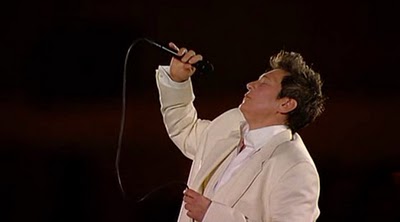
K.D. Lang, Leonard Cohen, and "Hallelujah"


[A little longer than usual, apologies, but you will see it's worth it]
I listened again to KD Lang's version of Leonard Cohen's Hallelujah. (Lyrics at the end). You might remember Lang performed the song for a live audience of 60,000-plus and some three billion television viewers worldwide at the Opening Ceremonies of the 2010 Winter Olympic Games in Vancouver. The Vancouver Sun reported k.d. "reminded the world that she is one of the best in the business, with a stirring, spiritual rendition of Leonard Cohen's 'Hallelujah' that literally hushed the crowd."

What is it about those lyrics, about that song which makes the world listen? At my squash club the other night, several guys were talking about Lang and her mesmerizing effect on them, especially "Hallelujah."

Maybe it's her soulful voice. Maybe it's Cohen's lyrics.

So I read them again. And again. And I hear references to the Older Testament. I hear references to modernism. I hear an aching and a pain in Cohen. I'm no LC expert, by any means. I'm a latecomer to his fan club. Some were around when he began in the 1950s. He was dark and Greenwich Village to me then. Now he's almost a guru to some. Some disavow his Jewishness because of his strange philosophies, to which he replied in 1997, "Anyone who says I'm not a Jew is not a Jew I'm very sorry but this is final so says: Eliezar, son of Nissan, priest of Israel;a.k.a Nightingale of the Sinai, Yom Kippur 1973; a.k.a Jikan the Unconvincing, zen monk; a.k.a Leonard Cohen"

After his Sydney concert in 2009, first in 24 years here, a woman/disciple named Irene wrote on his official page, "There were about a dozen full standing ovations through the show. At least. From tears to rapture to deep gratitude - all I am and belived and knew and lived was found manifest tonight. To say I love him just doesnt do it. THis isnt Love. Not as we usually know it. The G_D I KNOW , not one of religions, not one that was historical , biblical, causal, etc etc . HE was there in us around us in the music in each sound , in the Presence and in the story of life through all facets of being a human and Divine That Leonard brings as the Gift."

I think Irene was being poetic. And that's ok, although I prefer Cohen's poetry. He wrote in 1998 in classic Zen commitment, "But please do not follow, I've nothing to teach: except that the goal falls short of the reach."

But let's think about the song of conversation, though, "Hallelujah." The story begins with a praise to another song/hymn/psalm writer, King David. He lived about 1000 BCE in Israel and was originally a shepherd boy. He was the youngest of 8 brothers. (Found in the Bible in 1 Samuel chapter 16) And our introduction to him in the Bible is replete with a 'gee, shucks' kind of humility. Maybe that's why Cohen starts this poem with David. Although later on David is the sweet singer of Israel and known to play his kinnor, his harp, to soothe the king's troubled heart (King Saul), his beginnings are inauspicious. I think Cohen is projecting his own humility. And not badly at all. Maybe the capacity David/Cohen had/have to make people enjoy the music and to be calmed in their difficulties brings the word "baffled" to bear.

OK, next stanza.

The reference is to the sunbathing beauty on the roof, next door to the king's palace in Jerusalem. (Found in the Bible in 2 Samuel chapter 11) David has now become king and is at home in springtime. That's the usual time when kings go to war. David is not at war that year, that is, he's not leading the troops out. So he's on his roof and checking out the Israeli scenery and sees Bathsheba lying on the roof next door, and he's very attracted to her beauty. Long story short, David commits murder and adultery and practices lying...all to a very bad end. Not something you want recorded for yourself or about yourself in the Book of Books. But it's there. Stark, clear, detailed.

The details about tied up in a chair, though, that's poetry and not in the text. The cutting of the hair is a synthesis with another 'wrong woman' activity by another Bible hero, Samson. This one is found in the Bible in Judges chapter 16. Samson is the Jewish hero of the day, a judge he's called. And he falls in love with Delilah and she's from the wrong side of the tracks. She gets him to reveal his secret of his strength, in his long hair, and she cuts it and he loses everything he ever had. It's a sad tale, and stands equally stark in the Bible.

Even so, in David's case as well as in Samson's, they still gave thanks to God, and prayed to the last. The Hebrew word, Hallelujah means "Praise the Lord." It's an affirmation of His goodness, not ours. Samson's last prayer is “O Lord GOD, please remember me and please strengthen me just this time, O God, that I may at once be avenged of the Philistines for my two eyes.” (Judges 16.28) David ended the penitential psalm, Psalm 51, after the repentance over Bathsheba, with "Deliver me from bloodguiltiness, O God, Thou God of my salvation; Then my tongue will joyfully sing of Thy righteousness. O Lord, open my lips, That my mouth may declare Thy praise." (Psalm 51.14-15)

So Cohen's "from your lips she drew Hallelujah" makes sense.

I skip to the final stanza.

Maybe there's a God above. Yes, Leonard, and yes Virginia, there is a God above. Whether you or I or Donald Berwick or Julia Gillard or anyone says yes or no. But that's for another blog.

But the cold and harsh sounds of the final stanza are inconsistent with God-fearers. "But all i've ever learnt from love,
Is how to shoot somebody who outdrew ya,
It's not a cry that you hear at night,
It's not someone who's seen the light,
It's a cold and broken hallelujah"

OK, so if we take it at face-value, the cold is based on people's antagonism to each other. People shooting each other, people living in darkness, silent. That's cold, that's broken.

In other words, the only way to really sing an unbroken Hallelujah is to be a believer. I think I agree with Cohen yet one more time.

Do you enjoy the singing of KD Lang? Do you enjoy the praise word "Hallelujah?" God certainly does. He loves to hear us praise Him. He loves to have us live in light and live in the pleasure of good music and His good company.

Why would we go anywhere else? He loves us. He wants us to enjoy life today and each day. I think KD's singing of Hallelujah rang a chord in our hearts too. Let's sing it loudly. Praise the Lord!


Lyrics:
I heard there was a secret chord
That David played, and it pleased the Lord
You don't really care for music, do ya?
It goes like this
The fourth, the fifth
The minor fall, the major lift
The baffled king composing Hallelujah (repeat)

Your faith was strong but you needed proof
You saw her bathing on the roof
Her beauty and the moonlight overthrew ya
She tied you
To a kitchen chair
She broke your throne, and she cut your hair
And from your lips she drew Hallelujah

Hallelujah (repeat)

Baby i've been here before,
I've seen this room and ive walked the floor,
I used to live alone before i knew ya
But i've seen your flag on the marble arch,
Our love is not a victory march,
It's a cold and it's a broken hallelujah


Hallelujah (repeat)

Maybe there's a God above,
But all i've ever learnt from love,
Is how to shoot somebody who outdrew ya,
It's not a cry that you hear at night,
It's not someone who's seen the light,
It's a cold and broken hallelujah


Hallelujah (repeat)
Hallelujah, Hallelujah
Hallelujah

08 July 2010

Bob New Orleans Benediction

In 1987, some 23 years ago now this month, I stood with arms outstretched and blessed people whom I didn't know. Oh, I knew Vinson and Bill and many on the committee. I knew many in the Jewish stream, but hey, there were tens of thousands of people in the SuperDome that night. And no, I didn't know them. But I was convinced that God wanted to bless them and that I could act as a priest and bless them. The crowd was hushed.

I chanted the benediction (From the Bible, Book of Numbers chapter 6, verses 24 and 25). And then I translated it into English. And then all heaven broke loose. The crowd was released. The band struck up some Hebrew sounding, Jewish minor-key songs of praise and the people and the leaders on the platform and folks all over the place acted blessed. They shouted 'Glory!' and God was glorified. That sounds like blessing fulfilled.

Now it's 23 years later. I'm living in Sydney, Australia. I read a book by Vinson Synan the other day. I don't keep up with Bill. And some of the Jewish folks from that Congress on the Holy Spirit and World Evangelization in New Orleans and I keep up, mostly on Facebook. And today I'm pondering blessing again. What is it when someone sneezes and folks around issue the command, "God bless you?"

Wikipedia says a blessing "(also used to refer to bestowing of such) is the infusion of something with holiness, divine will, or one's hope or approval." Hmmm, is that what you think of?

All up, I want to live a blessed life, and for you to experience that as well. Some soccer (futbol) players feel blessed when they in Spain beat Germany or Netherlands took out Uruguay. "I"d like to thank God who blessed us with victory..." Hmmm, not sure on that one.

When someone comes through for you, you might say, "What a blessing!" And I'm with you there.

So how to live a blessed life, and to pass that on. That's a key question and one I'd like you to answer, if you can take a minute to do so. Or ten minutes. That would seriously bless me.

The 10 most pressing issues for evangelical theology today | Culture analysis | Sydneyanglicans.net

The 10 most pressing issues for evangelical theology today | Culture analysis | Sydneyanglicans.net

The 10 most pressing issues for evangelical theology today
Michael Jensen
June 29th, 2010

With a dash of hubris (why not, it’s a Monday morning) - here are the issues on which I think evangelicals have some work to do. Not that individual evangelicals don’t hold strongly to some of these - it is just that either the ‘traditional’ view is under challenge, or that there is a lack of consensus among evangelicals. This list is, like all lists, meant to provoke and challenge of course - it is meant (and I hope will be received!) in that spirit.

1 - scripture
How is inerrancy best to be understood and expressed - if indeed it is the most appropriate and useful word to express and uphold the highest possible commitment of the authority of scripture? Can we move beyond the use of the word as line in the sand and actually articulate what we mean by it in the midst of a post-biblical culture? Can evangelicals actually have a mature discussion about this - the word itself has become a shibboleth of US evangelicalism?

2 - God
Now that the ‘openness of God’ distraction has been (in my opinion!) overcome, there still seems to be a tension between the position known as ‘classical theism’ and the more ‘biblical personalist’ position. How are the attributes of God to be addressed, then, by the biblical Christian? Does classical theism help or hinder?

3 - election
Election is always a tough one. Double or single? Have new readings of Paul made a difference to what needs to be said about Israel? What is the purpose of the doctrine of election, dogmatically speaking?

4 - the atonement
Classic evangelicalism has always stood firm on the centrality of the atoning blood of Jesus Christ for the propitiation of our sins. But even between those who would agree that penal substitution is an indispensable part of the Bible’s teaching on the atonement - what place does it have within the whole scope of the Bible’s teaching? How does it relate to other descriptions of the atonement in Scripture?

5 - justification
The debate between NT Wright and John Piper over imputation reveals some fault lines. Imputation seems a necessary corollary of an evangelical testimony to justification by faith. But what are its exegetical foundations? And will ‘union with Christ’ prove to be a more fruitful model to explain this teaching? (with much good work to come from Moore’s own Con Campell)

6 - anthropology
I think theological anthropology is right at the missional cutting edge, and the more thinking evangelicals can do about it the better. That is not to fall prey to the temptation to collapse theology into anthropology, or to get distracted by all kinds of anthropologically interesting byways, but to give a full and rich account of the meaning and purpose of human life lived under the hand of the God who is mindful of man (to steal from Psalm 8).

7 - sin
Sin is a corollary of the doctrine of man… Once again it is a missionally urgent task to give an articulation of sin that is as full-orbed as we can make it. This is one instance where ‘biblically faithful’ and ‘culturally aware’ are not necessarily mutually exclusive. The mute incomprehension of our contemporaries as they hear contemporary preachers talk about sin highlights the problem… The answer is not in their hearts of course. The word of God is better than we think it is.

8 - philosophy & theology
Evangelicals seem genuinely undecided about this as a group. Is philosophy good, bad, or indifferent? A friend, or a foe? Is a philosophy-less theology simply naive? or is a philosophy in addition to theology a blasphemy? What have we to say about thinking?

9 - apologetics
A connected issue, then, is that of apologetics. Ought we to do apologetics at all? Many evangelicals have invested very heavily in apologetics. But to what end? Are the models of apologetics - evidentialist, presuppositionalist (does anyone actually understand what presuppositionalist apologists are saying?) - enough for the needs of the day?

10 - church
Evangelicals have always prided themselves on being ecclesiology-lite. They have achieved far more in terms of ecumenical co-operation than other forms of Christianity as a result. Ecclesiology is secondary. However, there are numerous settings where this needs to be revisited, given the rapid realignment of denominations and the retreat of Christendom. So you see some pretty heavy church-speak from evangelicals these days: the Nine Marks ministry says some pretty particular things ecclesiology-wise. The Federal Vision movement is likewise (though very different) heavy on sacraments and covenant/church talk. This is not an isolated trend.

11 - hermeneutics
I don’t mean hermeneutics in the sense of perspectival readings etc, but in the sense of asking the question: what makes the bible a unity? In what does a richly theological reading of Scripture consist? There are some very exciting developments on this front, building on the work of a previous generation - biblical scholars now collaborating with theologians on the matter of scriptural interpretation.

The Just shall live by faith: Shabbat Re'eh

  The Just shall live by faith Shabbat Re'eh 25 Av 5786 By Bob Mendelsohn 7-8 August 2026 Torah (Deuteronomy 11:26- 16:17) Haftarah (and...