Showing posts with label peace. Show all posts

09 August 2026

The Just shall live by faith: Shabbat Re'eh

 The Just shall live by faith

Shabbat Re'eh 25 Av 5786

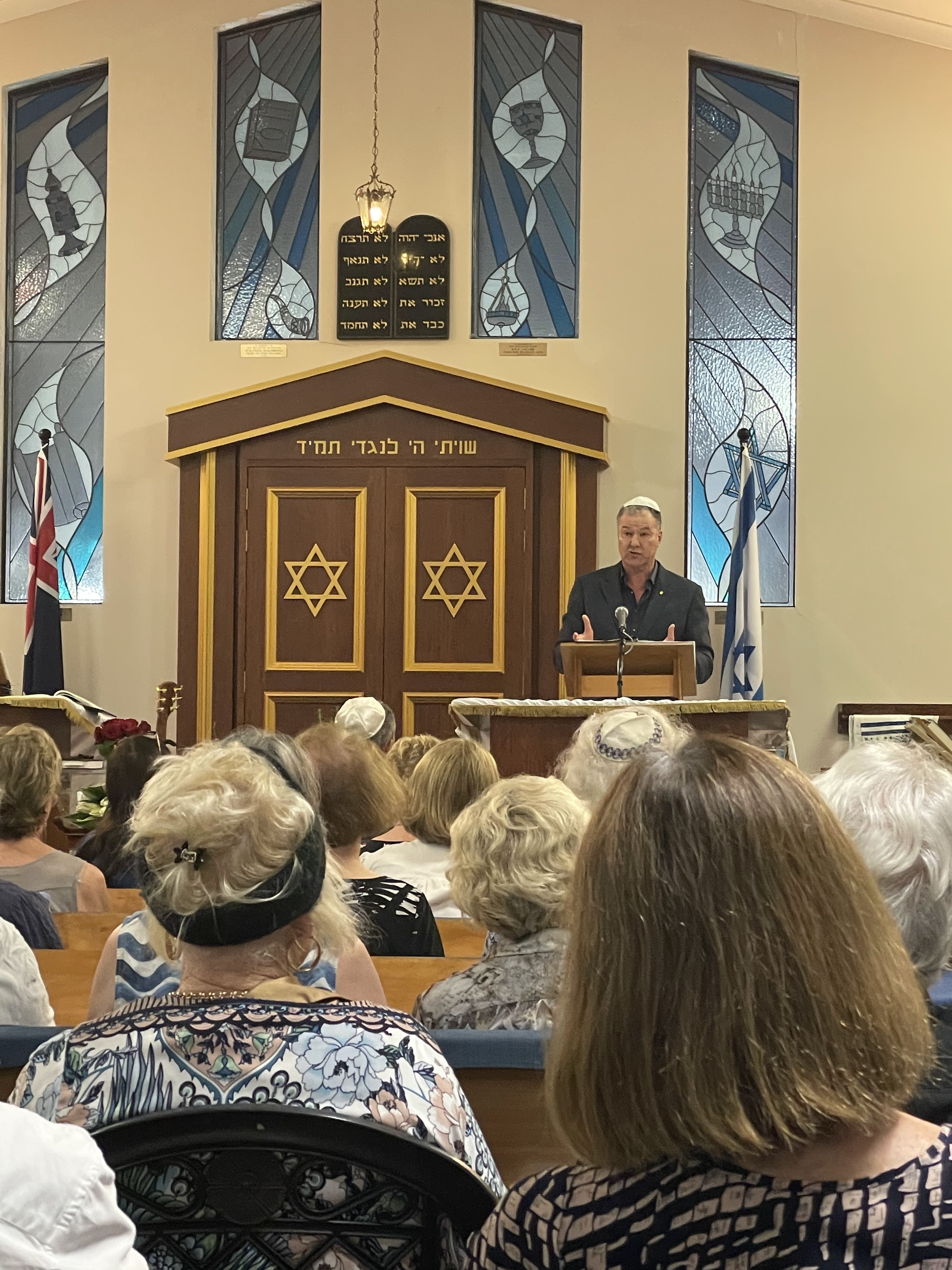
By Bob Mendelsohn

7-8 August 2026

Torah (Deuteronomy 11:26- 16:17)

Haftarah (and extension): (Isaiah 54:11 - 55:13)


Greetings

Shabbat shalom.

Thank you, Rabbi Kevin, for your kind invitation, and thank you to each of you here at Beth Hallel for welcoming me today. It's always a privilege to open the Scriptures together. My prayer is that what we study this morning will strengthen this congregation, encourage God's Kingdom here in Georgia, and reach even farther through the livestream and YouTube.

Let's see what the Lord has to say to us.


Introduction

Over the last two weeks, Rabbi Kevin has been leading us in a wonderful direction.

Two weeks ago, he began with Habakkuk 2:4: "The righteous shall live by faith." He called the message "Have Faith," and reminded us from Hebrews 11 that faith is not merely believing something is true—it is trusting God enough to live accordingly. I especially appreciated his illustration of praying for his mother during her illness. Faith allows us to remain faithful.


Then last week he spoke about Caleb and the ten spies. His message was titled Tenacity. Caleb refused to surrender to fear because he trusted God's promises. As we sang, God is worthy to be praised, why? He keeps his promises. Along the way Kevin quoted his father, my dear friend Rabbi Robert Solomon of blessed memory, who said, "Hanging on is like a loose tooth."


Now, in Tennessee, where I've been spending part of the summer, we have another expression: "He's hanging on like a hair in a biscuit." I'm not recommending either illustration before dinner, but both describe perseverance. Faith keeps holding on because God is worth trusting.


Today’s parashah is Re'eh—"Look."

That simple command becomes the thread running through everything I want to say today. Because I believe this week's Torah portion, together with its Haftarah, answers one of the biggest questions many sincere believers wrestle with:


How do we obey God without becoming trapped in performance? Or to say it another way:

How do righteousness, peace and joy fit together? I want to suggest today that the answer begins with one simple command.


Look. Look to the Lord.


This is easy to say; it’s not easy to make happen. So many other things cause us to look away. We sang, “lift up your eyes and see him coming.” Like Peter in the water, he stood distracted, divided, by the water and the call of Yeshua. 

My question—how do we see God when so many other things are grabbing at our attention?  Today we will try to unpack the answer to that enigma.


What is the summary of the Tanakh?

There's a famous discussion in the Talmud (Makkot 24a). It traces how the 613 mitzvot were gradually summarized through Israel's history.

Moses gave us the 613 commandments.

David summarized them into eleven in Psalm 15.

Isaiah reduced them to six. (Isaiah 33:15)

Micah famously reduced them to three:

"Do justly, love mercy, and walk humbly with your God." (6.8)

Isaiah later summarized them into two: "Maintain justice and do righteousness." (56.1)

Then comes the final question. What is the one great summary of the whole Tanakh? The answer may surprise you.

Habakkuk 2:4. "The righteous shall live by faith."


That is why I appreciated Rabbi Kevin beginning there two weeks ago. He wasn't simply choosing a favourite verse. He was pointing us toward one of the great summary statements of all Scripture. And that verse becomes the key that unlocks much of what we're reading today.


What does emunah really mean?

The Hebrew word in Habakkuk is emunah. It's richer than simply "believing." It carries the ideas of faithfulness, steadfastness, trustworthiness and loyal dependence upon God. Over the centuries Jewish interpreters have understood this verse in slightly different ways.


Some emphasized our faithfulness—that God's people are called to remain loyal to Him, especially during difficult times.


Others, particularly through the Septuagint, emphasized God's faithfulness—that life depends upon His covenant promises rather than our own strength.


Still others connected faithfulness with careful obedience to Torah.


Then comes Yeshua and the writers of the New Testament. Rather than choosing only one of those ideas, they bring them together. We live because God has proved Himself faithful, supremely through Messiah Yeshua. And because He is faithful, we place our complete trust in Him.


Faith is not passive agreement. Faith is active reliance. That's why Habakkuk became such a foundational verse for Paul and for the writer to the Hebrews. (Romans 1.17; Gal. 3.11, Heb 10.38)


When I was growing up as an Orthodox Jewish boy in Kansas City, I understood religion largely in terms of performance. Be Torah compliant. Try harder. Do better. The weight rested on my shoulders.

Many sincere religious people—Jewish and Christian alike—still live that way today. But after coming to know Yeshua, I discovered something wonderfully freeing. Our acceptance before God rests first on His faithfulness, not ours. Our response matters enormously. Obedience matters. Holiness matters. Torah matters.


But they become the fruit of a relationship, not the price of admission. That changes everything. Because once you know you are right with God, something remarkable follows.


Righteousness produces peace. And peace produces joy. That's where we're going today.


Righteousness, Peace and Joy

There's a verse in Romans that has become increasingly precious to me over the years. At the end of Paul's discussion about Torah, food laws, and life together in the community of believers, he writes: "The Kingdom of God is not only about eating and drinking, but righteousness, peace and joy in the Holy Spirit." (Romans 14:17)

Notice the order. Not peace, righteousness and joy. Not joy, peace and righteousness.


First comes righteousness—being right with God. From that flows peace. And from peace comes joy. I don't think that's accidental.


So many people are trying to find peace by trying harder. They're striving to become acceptable to God. They're hoping that if they pray enough, obey enough, give enough, serve enough, perhaps then they'll finally experience peace.

But Paul reverses the order. When you know that you're right with God through His grace, peace follows naturally. And when peace settles into your soul, joy isn't far behind. That's why Paul says the Kingdom isn't ultimately about eating or drinking. It isn't about arguing over what we may eat or when we may eat it. Those discussions have their place, but they aren't the centre of the Kingdom.


The centre is this: Right with God. At peace with God. Filled with joy because of God.


Let me make one clarification. Joy is not the same thing as happiness. Happiness depends on things happening to happen the way you want them to happen. If everything goes your way today, you're happy. If it doesn't, happiness disappears almost as quickly as it arrived. Joy is different. Joy remains because your relationship with God remains. Joy is the quiet confidence that comes from knowing you belong to Him.


That's why Yeshua could say on the night before His crucifixion, "My peace I leave with you. My peace I give to you—not as the world gives." (John 14.27) And a little later, "In this world you will have trouble. But take heart! I have overcome the world." (John 16.33)

Notice what He did not promise. He didn't promise an easy life. He promised His peace in the middle of a difficult life. That's a very different promise.


Paul later says of Messiah, "He Himself is our peace." (Ephesians 2.14) Not merely the giver of peace. He is our peace. When we're right with Him, peace follows. And where peace lives, joy begins to flourish.


A lesson I never forgot

May I tell you a story? More than twenty years ago, at Messiah Conference, I learned something I'll never forget.

Rabbi Robert Solomon was there, as always, with Miss Dottie. I was representing Jews for Jesus in the marketplace. One afternoon I was invited into a gathering of rabbis. The discussion turned to a book that hadn't even been published yet, but somehow it had already become controversial.


Then my friend, Rabbi Joe Bell from Tennessee, looked across the room and said, "Bob can answer that." I remember thinking, "Really?" None of us had read the book—including me. Yet suddenly I found myself standing at the front of the room answering questions about it. Most of the rabbis had welcomed the author of this book to their pulpits over the years to share his story of faith.


To be honest, it felt less like a question-and-answer session and more like an inquisition. After collecting my thoughts, I simply said, "None of us has read the book. I haven't read it. Let's not judge a brother before we've even read what he's written." The conversation continued. Questions came. Answers came. Eventually the meeting ended.

People were gracious—they even applauded. I survived. About ten minutes later Rabbi Robert walked past me in the hallway, smiled that wonderful smile of his and said, "Bobby... you dodged a bullet." I'd never heard him use that expression before. By the end of the week, he'd said it several more times. I've never forgotten it.


Not simply because it was funny. Because throughout that entire afternoon I experienced something remarkable. Peace. Not because I knew every answer. But because I honestly believed I was trying to honour the Lord with the right spirit. Sometimes peace doesn't come from having all the answers. It comes from knowing you're standing in the right place before God.


Holiness is a community project

That experience also taught me something else. One of the great temptations in both churches and Messianic congregations is to make holiness almost entirely personal. When I visit congregations around the country, I often notice something before the service even begins.

I watch where people sit.


Seriously. People naturally sit near people they know and love. If everyone is scattered with great empty spaces between them, I already know I'll have an uphill battle talking about community. Because biblical holiness was never intended to be a solo project.


Suppose today we were studying Leviticus 19. Most of us would immediately start examining our personal behaviour. How am I doing? Am I praying enough? Reading enough? Giving enough? Serving enough?


Those are good questions. But they aren't the only questions. Much of Torah isn't simply asking, "Am I holy?" It's asking, "Are we becoming holy together?"


Think about leaving the corners of the field unharvested. (Lev. 19.9-10, 23.22) That command wasn't simply about making the landowner holy. It was about feeding the poor while preserving their dignity.


Think about Job. (31.13-28). Or think about the prophets. Think about Yeshua teaching the disciples to pray,

"Our Father..." Not My Father. "Give us..." not me. "Forgive us..." "Deliver us..."


Biblical faith is wonderfully personal. But it is never merely private. We need one another. That's why encouragement matters. Like Rabbi Robert gave me that week. That's why accountability matters. That's why we pray together. That's why we confess our sins to one another. That's why congregations matter.

God isn't simply creating holy individuals. He's creating a holy people.


Resting instead of striving

Let me bring us back to this week's readings. Shabbat is God's weekly reminder that the world keeps turning even when we stop working. That's harder for some of us than we'd like to admit. If I'm always striving, I'm never truly resting. If I'm always trying to prove myself to God, I'll never enjoy the God who welcomes me. Shabbat was never intended to become another competition.


It's an invitation. An invitation to trust. An invitation to stop performing. An invitation to rest in the goodness and faithfulness of God.

Checklist Religion is how many people simplify their walk with God. If you satisfy his commandments, then you are feeling good about yourself. You think you have succeeded, and honestly, we often feel smug and prideful. Alternatively, if you fail last week, reviewing your actions or inactions, and you determine that you didn’t get a perfect score. You often feel condemned by your failures. Listen, to every checklist religionist, there are only two possible outcomes—pride or condemnation. Neither of which are from heaven.


Isaiah points us in the same direction (55.7-13)

To counter the notion of a checklist religion, listen again to our Haftarah. God says, "My thoughts are not your thoughts, neither are your ways My ways." We often quote those words in isolation but look at the context. Just before that He says, "He will abundantly pardon." That's the point.

God's ways are not our ways. If we were God, we'd probably keep score. We'd make people earn another chance. We'd remember every failure. God says, "I abundantly pardon." Do you believe that? Or do you secretly think God spends His time waiting for you to make your next mistake?


Isaiah goes on to say, "You shall go out with joy and be led forth with peace." There it is again.

Joy. Peace. Exactly where Paul takes us in Romans. When we're right with God, peace follows. When peace settles into our hearts, joy begins to overflow. No wonder Isaiah pictures the mountains singing and the trees clapping their hands. Creation itself celebrates the grace of God.


Re'eh—Look. Don't miss the title of this week's parashah.

Re'eh. Look. The rich young ruler came to Yeshua. (Mark 10.21) Mark tells us something beautiful. "Yeshua looked at him and loved him." Before He challenged him... Before He called him... Before He exposed the one thing that held his heart... He loved him. What if that's how God looks at you?


Then think about Peter. After denying Yeshua three times, the rooster crowed. Luke tells us, "The Lord turned and looked at Peter." (Luke 22.61) Can you imagine that moment? Not a look of hatred. Not a look of disgust. A look that broke Peter's heart because it reminded him that he was still loved.

Then think about Stephen. As the stones began to fall, what did he do? He looked up. He saw the glory of God. He saw Yeshua standing to welcome him home. (Acts 7.55)


Three different people. Three different situations. One command. Re'eh. Look. Look to Him.


One last story

Years ago, I heard a story about an Italian peasant who looked into the sky and became convinced that Jesus was returning. He ran to tell his parish priest. The priest looked up and immediately hurried to tell the bishop. The bishop hurried to Rome. Eventually they stood before the Pope.

"Holy Father," they cried, "look up! Jesus is coming!" The Pope went to the window and looked out and quickly returned to his desk, grabbed a pen and started writing furiously.


Finally, the peasant asked, "Holy Father... what are you doing?" The Pope replied, "Jesus is coming... Look busy!"


I love that story. Because I'm afraid that's exactly how many religious people think. "Quick! Do something religious! God's watching!" No. That's not the Gospel. That's not Isaiah. That's not Paul. That's not Yeshua.


So, what should we do?

Should we obey?

Of course. Should we pursue holiness? Absolutely. Should we care for the poor? Without question. Should we love one another deeply? Yes.


But none of those things earns God's love. They flow from God's love. Good works are the fruit of salvation. They're never the price of admission. That's why Isaiah invites us, "Why do you spend your money on what is not bread? (55.2)... Listen to Me (.2)... Come to Me (.3).. Hear, that your soul may live. (.3)"


The invitation isn't, "Try harder." The invitation is, "Come to Me."


This is the season of comfort

These weeks after Tisha B'Av are called Nachamu—and include seven weeks of comfort. For Israel, they prepare us for hope after judgment. For those of us who have found Messiah, that comfort doesn't last merely seven weeks. It lasts forever.

Isaiah says, "Turn to Me and be saved." (45.22) Not, "Impress Me." Not, "Perform for Me." Not, "Earn My approval." Turn to Me.


Conclusion

So let me leave you with the simplest word in this week's parashah.

Re'eh. Look.


Look to the One whose faithfulness never fails. Look to the One who abundantly pardons. Look to the One who makes us righteous—not because we have earned it, but because He is faithful.

And when you know you're right with Him... You'll discover peace. A Shabbat of peace, or as we say Shabbat Shalom. And beyond today, where peace lives... Joy quietly follows.


Yes, the King is coming again. Until then... Let's care for one another. Let's make holiness a community project. Let's encourage one another. Let's welcome the stranger. Let's lift the weary. And above all...

Let's not merely look busy. Let's look to Him. For the righteous shall live by faith.


Amen?


One final word. 

You might know that I’ve worked with Jews for Jesus for the last 47 years and had the privilege to know your founding rabbi when this gathering was called Jewish believers and friends. I remember hosting Miss Dottie when she was going to NYC to get the Torah decorations, the rimmonim, the Ner Tamid, and making a deal. She trusted me to help her both on the Lower East Side and over in Brooklyn. Good times. I remember being there near the beginning of the congregation in Indianapolis where little Dara was learning to play piano with her family, and her dad who was a university music professor – imagine!


God has been kind to keep me for all these decades and to bring His will in my life. To help me “look up and live” (Numbers 21.4-9) like the wilderness Israelites did when the snakes were biting our life out of us. God has saved me and kept me by his promises. I’m surrendering to him, that I will look up this Shabbat, and will make this commitment again on Sunday, and God willing every day until He returns. 


As a missionary, I’ve served in the US and the last 28 years in Sydney. Let us keep serving him as a fruit of our looking up to gain his life in us today and from now on.

Shabbat shalom!


---------------------------------------------------------------    

For more information about Bob, check his website TheRealBobM.com

For more information about Jews for Jesus, check the web at JewsForJesus.org

For more information about Congregation Beth Hallel, check out https://bethhallel.org/


08 October 2024

Tragic Days and Glorious Days and today

 Some tragic human days include:

11th of September 2001 (Nicknamed 9/11) when four airplanes were hijacked and over 2,700 people were killed in the USA

7th of October 2023 when over 1,200 Israelis were killed at a music festival in southern Israel by Hamas terrorists, and raped, and another several thousand were injured or kidnapped

15th of April 1865 when the 16th president of the USA, Abraham Lincoln was assassinated at Ford's Theater in Washington, DC

20th of April 1999 at Columbine High School in Colorado when two teens killed another 15 students on the birthday of Adolf Hitler.

7th of December 1941, Pearl Harbor Hawaii, Japan attacked the USA to spread the Second Wold War into that region. 2,300 Americans were killed and another 1,100 were wounded.

22nd of November, 1963. Three famous people died: Aldous Huxley, CS Lewis, and John Kennedy. The last was assassinated in Dallas, Texas. Another fatal tragedy in US history.

24th of August, 1814. Washington, DC was burned!

And the list could continue in country after country, decade after decade, and you might wonder why I'm writing about all these.

July 1931, China Floods. 4 million died.

1900, Galveston, Texas. Another hurricane. 

September 1887, Yellow River Flood, 2 million died.

After writing about all these and so many other tragic days, I began a list of glorious days, good days, and winning days, when people shouted, 'Hurray!' and pleasure finally trumped tragedy.  But some were only personal when I graduated from university or received my Master's degree. Some were related to my family like when my kids stepped into adulthood, one by one, and stepped out of the shadows. My wife's graduation with her Master's degree; my son's first television appearance, my daughter's dancing in the Nutcracker, and the list continues but to be fair, they are all personal.

OK, so what about 'corporate' glorious days? Would that be the back-to-back Super Bowl victories of the Kansas City Chiefs? Or beyond sports, my political favourite won that mayoral or presidential race.  Why is it so much easier to remember trauma than personal triumph?

Andrea Bonior wrote in Psychology Today last year (https://www.psychologytoday.com/au/blog/friendship-20/202312/traumatic-memories-really-do-feel-different) "People who have experienced trauma have a different relationship to those memories than they would to memories of typical, everyday events. Even memories with negative emotional connotations, like sadness, still seem to be in a different category than memories of trauma—where shock and helplessness force the body into an extreme threat response. The intrusion that comes with re-experiencing traumatic memories often involves the entire body and can send people into devastating cycles of flashbacks, nightmares, and even dissociative states."

Bonior cites recent studies and concludes: "These memories are perhaps less akin to how we think typically of recalling an experience and instead are more like reliving that experience. Trauma therapists and trauma survivors have long conceptualized trauma this way, as the body truly revisiting the experience, but to have actual scans of brain activity conveying the difference in these concrete ways is an important step forward."

Last night was 7 October here in Australia and I attended a commemorative service and vigil on the Gold Coast. The mayor spoke; the rabbi spoke; a Christian pastor spoke; and we sang some songs of peace. "Never again is now" was cited by at least two of the speakers and the spirit of the gathering was peaceful and supportive of the Jewish people. 

Of course, one year ago in Israel, over 1,200 people were taken, slaughtered, raped, killed, and hundreds more were injured. Actually, all the people were injured as were most of the world's Jewish population. Tragedy launches the 'shock and helplessness' I felt again last night, which for many here in Australia is continuing.

We desperately long for peace. Or do we? As I sat in the crowd last night, listening to the powerful remarks by the mayor of the Gold Coast, I wondered if those who straddle the middle road are intent on real peace. The rabbi declared that the Greens are not interested in the environment, but are filled with hate. Many in the crowd agreed with those who oppose Penny Wong, our Foreign Minister, as she double talks about Israel and peace. 

How can we proclaim peace at this time?  

How will you proclaim peace?

Yes, tragedies are powerful, and PTSD is well documented. Can we find hope on 8 October? Can we find hope on 5 November? Can we find hope any day?

What will you do to make your world a better place?

07 August 2021

Holy War: A study to start a conversation


To view this as a video: https://youtu.be/EZo_GahmIhY 


War. What it is good for?

When I was a kid, playing Risk, the board game, was a game of war. The card game ‘war’ was a battle between two warring peoples. No blood was as usually spilled. Playing war often in the back yards of our houses was between cowboys and Indians, and we used sticks as weaponry, only as pretend guns.  

Maybe I moved up a notch and played Battleship against a friend in our afternoon playtime. War was nothing but often was everything.


On the television, Hogan’s Heroes and McHale’s Navy showed nothing of World War II but was all I knew of it. My father never spoke about his experiences in the US Navy unless we almost demanded to know, and we rarely asked.

War in my childhood was frivolity and entertainment. I lived between WWII and Vietnam. It wasn’t real at all.

Then I turned into a teenager and Vietnam was in focus and in the late 60s became the subject of nightly news like we are seeing the last 18 months with Covid updates. Vietnam was the first televised war, almost live and in colour. I didn’t know much about it, but I knew one thing, war—what is it good for? Absolutely nothing.

Since then, of course the world has changed, but I want to talk today about war, even biblical war, and I get it. We are in unfamiliar territory here today. I’m speaking about a topic and not helping us get through a chapter of the Bible. And we are also speaking about a topic that is very unfamiliar to most westerners in the 21st century—the topic of war. And finally, we are going out on the proverbial limb as we address war in the Bible itself, sometimes called ‘holy war’ and sometimes words without the adjective ‘holy.’ We have a lot of information to get through, so in the first 30 minutes or so, I will try to lay out what I have found. Then in the final half hour we will let everyone in on the zoom call, and we can discuss this with your questions or comments. 

If you haven’t yet subscribed to our YouTube channel, please do so today, by clicking that little red and white ‘subscribe arrow’ and please click ‘like’ so you will help many others to find our channel as well. Thanks.

Holy War, what is that?

We will cover some topics, but seriously, I want you to investigate and ponder the depths of ideas like Jewish laws concerning war, the problems of war in Jewish history, the purposes of war, God’s intervention in war, war and peace, and finally can I really call something VonRad called ‘holy war?’ 

We know God will make wars to cease (Psalm 46.9) and that there is a time for war and a time for peace (Eccl. 3.8). Yeshua said the end would be characterised by wars and rumours of wars. (Matt. 24.6). We know the Messiah, the Lamb of God, who sits on the white horse (Rev. 19.11), the Faithful and true, judges and makes war. In other words, there is a year’s worth of information to unpack. I encourage you to start today, but don’t finish. Let’s jump in.

Older Testament stories

We have spent considerable time in the last 18 months looking at the history of the Jewish people, and it’s impossible to study that without noticing how often God tells Israel to conduct a war against their enemies. From our beginnings, leaving the slavery in Egypt, God is called ‘a man of war.’ (Exodus 15.3) But even before that, and perhaps even more fundamental is the account of Abraham fighting to retrieve his nephew Lot recorded in Genesis 14. The four kings had taken Lot and much of Abraham’s goods. Abraham gathered 318 military folks and they fought a battle; they won the battle and the story ends. 

Later, in our studies in Torah and certainly in the book of Joshua, God instructs the Jewish people to initiate and conduct wars against the 7 nations that abound in Canaan in 1400 BCE, and to take it for their possession. The words are clear. The imagery is clear. It’s God’s land and he wants his people who will represent him  to live there. That displacement requires war. And dear friends, that biblical war is the basis of what every people group after that time has used to justify their own ‘just war.’ 


Whether it’s the Crusades of the medieval period, the Irish Catholics vs the Protestants in the 20th century, or the Jihad of the Muslim terrorists in 9/11—just war, or holy war, is in question today. Is it ever right? Is it right for us?

Mike Southon works at Youthworks and received his bachelor’s degree from Moore College here in Sydney. His major thesis in 2011 was on pacifism and just war. He said of the OT period, 

“It starts with war as the role of Israel as they conquer and then defend the land. As the land is secured and the history of the nation progresses, Israel is no longer commanded to war. Instead, God protects (or punishes) them by his sovereign control of the nations to achieve his purposes – regardless of Israel’s military strength or weakness at the time. 


Southon argues in his thesis that two other factors must be noticed. Providence and prayer should take more significant roles in our understanding of the Scripture rather than being committed to national conflicts being solved in military engagement. He said that prayer is not doing nothing, in fact, the actions of Yeshua and of Paul and even John testify to their conviction that striking back is not God’s answer, but letting your requests be made known to God is active and accomplishes much. 

Southon also highlights Providence since the people of God after the times of the Judges and certainly in the Psalms and later prophets look to God rather than to their own weaponry. He said, 

“Finally, in the later prophets, the theme of war is transformed completely into the future, looking towards God’s eschatological defeat of his enemies. In fact, this shift in theological focus looks fairly like the developing theology of the Temple throughout the Old Testament.”


Of course, war in the Jewish world does not begin with the conquest of Canaan, but as I’ve said, with Abraham retrieving his nephew. One of Mike’s friends wrote Mike about the Abraham passage

There is nothing in the text (Genesis 14) to suggest that God commanded Abram to take military action, though he clearly gave him success in that action. I don’t see a connection to a previous command or promise, either, as Lot was not included in the promises (he was not to inherit the land, etc.). The only justification for Abram going to war seems to be his concern for the welfare of his relative: “When Abram heard that his kinsman had been taken captive, he led forth his trained men …” (Gen 14:14, ESV). To me this seems to suggest that there are generally acceptable reasons to go to war without the need for a direct command from God.  If you would say that Genesis 14 is OT and the coming of Jesus has changed all that, I don’t understand why. Why would the death and resurrection of Jesus nullify previously good reasons to go to war? … Christ’s defeat of his enemies is assured but not yet complete (1 Corinthians 15:25). Wouldn’t there still be a place for just war until that victory is complete?


In my research for today’s lesson, I find most Christians believe in war as a protection against evil.  When we see injustice in Germany in World War II or in South Sudan or in Kuwait, we should get involved, they say. By that I mean when a neighbour is in need, being beaten or threatened, it seems right and permissible to defend that person against the intruder. And isn’t that a biblical precept? What about when nations are being harassed and people in cities are threatened by outsiders and marauders? Is it right to defend them against the perpetrators? 

Consider these two texts. First from Torah.

Deuteronomy 22.23-27

“If there is a girl who is a virgin engaged to a man, and another man finds her in the city and lies with her, 24 then you shall bring them both out to the gate of that city and you shall stone them to death; the girl, because she did not cry out in the city, and the man, because he has violated his neighbour’s wife. Thus, you shall purge the evil from among you. But if in the field the man finds the girl who is engaged, and the man forces her and lies with her, then only the man who lies with her shall die. 26 “But you shall do nothing to the girl; there is no sin in the girl worthy of death, for just as a man rises against his neighbour and murders him, so is this case. 27 “When he found her in the field, the engaged girl cried out, but there was no one to save her.”


Here the issue is the crying out. Why? Because if she’s in the city and didn’t cry out, then she is culpable. If she’s in the field, and she cries out, ‘no one was there to save her.’ Fighting literally to defend a damsel in distress is not only characteristic of a hero in a fairy tale, but also significantly biblical. 

One more text. After Esther and Mordecai produce greatness in Shushan in the Purim story. Chapters 8 and 9 show the end of the story with the killing of the 10 sons of Haman, but also includes the edict of Ahasuerus.

“In them the king granted the Jews who were in each and every city the right to assemble and to defend their lives, to destroy, to kill and to annihilate the entire army of any people or province which might attack them, including children and women, and to plunder their spoil.” (8.11) As a result of the edict, we read this in chapter 9 

“Thus, the Jews struck all their enemies with the sword, killing and destroying; and they did what they pleased to those who hated them. At the citadel in Shushan the Jews killed and destroyed five hundred men.” (9.5-6)

“Now the rest of the Jews who were in the king’s provinces assembled, to defend their lives and rid themselves of their enemies and kill 75,000 of those who hated them; but they did not lay their hands on the plunder.” (9.16)

This killing of 75,500 people in the provinces of Persia sounds like wars of defence rather than wars of offense, which may help some to sort out the military actions described in the end of an otherwise Jewish morality play in the book.

Problems of war in the Bible

We who know the book or who know the Author of Life at all, know that we messianic folks usually comment on war and victories when we celebrate the death and resurrection of Yeshua, in his battle with Satan in the Temptations and in the final temptations at Calvary and the Garden of Gethsemane. Because Yeshua died and rose from the dead, which so far, we title the ultimate victory, we don’t usually ponder military actions. Today we are pondering those fights and battles from Older Testament. They seem like distant memories, but they inform us of God’s heart which is how anyone should learn and properly define theology, going forward.

The battle belongs to the Lord

One of my favourite Older Testament chapters is found in 2 Chronicles 20, a landmark history section. There the Judean king Jehosophat is featured as seeing the handwriting on the proverbial wall that Ammon and Moab and Mt Seir are gathering to take some of the land of Israel away from the Jewish people. 

Look at verse 3 of 2 Chronicles 20. “Then Jehosophat was afraid and turned his attention to seek the Lord and proclaimed a fast throughout all Judah.” The king calls a fast for Judah and the people respond. 

Verse 13 says all Judah was there, standing, before the Lord, including infants, wives and children.” The Spirit of the Lord came on a certain Levite, Jahaziel who prophesied victory. Why? “The lord is with you” (v. 17) Jehosophat bowed down, everyone bowed down, the Levites led a ‘very loud voice’ worship service (.19)

The next day Jehosophat declared to Israel twice to “trust in the Lord”, singers led worship again, and the three enemies fought each other, and Judah was spared. 

Dear friends, this victory stands out both in its unusual manner and in its understanding of Providence and Prayer. The king saw the problem. He sought God. He invited the people to seek God. God answered in a way no one would have ever imagined. 

Raymond Dillard in the Word Biblical Commentary says this. “The modern historian may be tempted “to poke fun at Jehoshaphat in Chronicles for sending out the temple choir to meet an invading army; it is still funnier when the choir puts the foe to flight and causes great slaughter with a few well-directed psalms” (W. Stinespring, JBL 80 [1961] 209). Though the role of the musicians may be enlarged or enhanced in the eyes of a modern historian, one must not forget the role of music in warfare ancient and modern; armies through the millennia have gone into battle to musical cadence. Particularly within Israel’s tradition of holy war, music has been assigned an important function (13:11–12; Josh 6:4–20; Judg 7:18–20; Job 39:24–25); music accompanies the appearance of the divine warrior to execute judgment (Ps 47; 96; 98). Yahweh marches at the head of the armies of heaven and Israel (Deut 33:2–5, 26–29; Josh 5:13–15; Judg 5; Ps 68:8–13; 2 Kgs 6:15–19; 7:6; Isa 13:1–13; Joel 3:9–12 [4:9–12]; Hab 3); his appearance on the Day of Yahweh is marked by a trumpet blast (Exod 19:16, 19; Isa 18:3; 27:13; Amos 2; 2; Zeph 1:14–16; Zech 9:14; Matt 24:31; 1 Cor 15:52; Rev 8–9; 10:7; 11:15).”

I guess what I’m saying is that the role of prayer and confidence in God’s sovereignty appears in this history section to have replaced the role of military might and dominance.

Maybe this in hinted in the conquering of the Philistines under David or even Samson. In David’s case, we read that a small lad takes on the powerful Terminator played by Goliath. We don’t send Bruce Willis or Liam Neeson to win; we send Frankie Muniz (Malcolm in the Middle) or Theodore “Beaver” Cleaver out to beat up our mortal enemy. 

In Samson’s case, he uses the jawbone of a donkey to slay the enemy. And ends up pushing down the false temple in his blindness.

Maybe the words of Paul should be said, 

“God has chosen the foolish things of bthe world to shame the wise, and God has chosen the weak things of bthe world to shame the things which are strong,” (1 Cor. 1.27)

Dear friends, I’m not talking today about a biblical and national response by Australia against an invading horde from PNG. I’m not giving military advice to the US Secretary of Defence considering Afghanistan. 

Christopher Wright says this.

“(Deuteronomy 20) does not pretend to be a manual for military operations and it is hermeneutically futile to read it or criticize it as if it were. Rather, as in the law of the king (which is no manual for government administration either), it is concerned with fundamental principles, principles that must govern Israelites at war as in any sphere of life. The two most basic covenantal principles of Israel’s life under God were: love for Yahweh (Deut. 6.5) and love for one’s neighbour. This vertical and horizontal duality was fundamental to the covenant dynamic. Love for God can be seen operative in the opening challenge of Deut. 20.1-4, but is there any way that love for neighbour can be operative in the context of war? Two responses may be made to this question.

“First, love of neighbour clearly does not mean a facile niceness to everybody in all circumstances. Love of neighbour is not incompatible with discipline and punishment. One’s duty to one’s neighbour may include for example, the duty to expose the apostate or idolater or to execute the criminal. Love of neighbour did not exclude the need to ‘purge the evil from among you‘. On a wider canvas, likewise, the historical execution of divine justice upon the wickedness of the Canaanites is not incompatible with the overall belief in God’s ultimate intention to bless the nations through Israel. Nor does it prevent the remarkable degree of social compassion and legal protection afforded to the foreigner within Israel, even in Deuteronomy. The mere fact, then that Deuteronomy makes provision for war does not invalidate all it has to say concerning human ethical duties of compassion, neighbourliness, and generosity.

“Secondly, it is precisely within the imperfections and fallenness of human life that love for neighbour has to operate.  Deuteronomy is well aware that sometimes the priority is to work for the humane within the inhumane, to mitigate the worst effects of human sin, to control the worst human instincts, to protect the interests of those most vulnerable in contexts of brokenness (in its laws on polygamy, slavery, and divorce). Seen from this perspective on the one hand and in the light of the horrors and extremeness of cruelty in ancient warfare on the other, the provisions of Dt. 20.5ff and 21:10-14 are an exercise of neighbour love within the constraints of the grim reality of warfare.“ (Wright, page 227-8) 

The ideas Wright brings up are remarkably consistent with our concerns in these days. We don’t want to forget the Geneva Convention, and that ethic has its beginnings, not in Switzerland, but in the Scriptures.

“The term ‘holy war’ has been increasingly criticized as inadequate and misleading. “Yahweh war’ has been preferred for expressing the fact that some of the wars of Israel were described and celebrated as the wars of Yahweh against his enemies. It should be remembered that not all the wars fought by Israel in the OT fall into this category, and sometimes kings were prophetically challenged over wars that were not sanctioned by Yahweh. 

“As regards the humaneness of the warfare during the conquest or monarchy eras. While it is true that Israel’s practice did not follow what is prescribed here, it seems to be as likely that the idealization preceded Israel’s wars in the land as that it was a 7th century post-idealization of what should have happened, but everybody knew had not. It is hard to see what possible point the distinctions of Deut. 20.10-18 would have had centuries after the actual settlement of Israel in the land, or indeed what purpose Deut. 20 would have served at all in relation to a 7th century reformation.

“As regards the moral and theological question of how Christian readers of the OT should view the wars of the OT, or the kind of instructions given in this chapter. We should note first the degree of humaneness and restraint in Deuteronomy’s laws of war, which is often overlooked in generalized criticisms of ‘OT violence.’  Secondly one must be careful to set the whole issue of war in the OT in the theological context in which it is clearly set in Deuteronomy.  It is seen not merely as a matter of Israel’s supremacy over the nations, but of Yahweh’s supremacy over all other gods and as the exercise of Yahweh’s legitimate moral judgment on human wickedness in the context of God’s overall sovereignty in history.” (Ibid. page 231)

At the end of the day, when Isaiah’s prophecy is finally realized,

“He will judge between the nations and will render decisions for many peoples. and they will hammer their swords into plowshares and their spears into pruning hooks. Nation will not lift up sword against nation, and never again will they learn war.” (Isaiah 2.4)


Until that day, let us be using the weapons of our warfare to bring down strongholds

“The weapons of our warfare are not of the flesh, but divinely powerful for the destruction of fortresses. We are destroying speculations and every lofty thing raised up against the knowledge of God, and we are taking every thought captive to the obedience of Christ, and we are ready to punish all disobedience, whenever your obedience is complete. (2 Corinthians 10.4-6)

Let God be exalted in your life.

Let Yeshua be the one who vindicates you.

The apostle Paul told us in Messiah that we are to use the weapons of our warfare to exalt Yeshua. He wrote the Ephesians that we are to have military garb on, but not to go out and brutalize people. Our war is not against ‘flesh and blood’. We should have a shield of faith, a helmet of the hope of salvation, the Gospel of peace on our feet, and carry the “Sword of the Spirit” which is the Word of God.

Somehow we have lost the plot and made military weaponry into our confidence. Enough of us ought to be able to take down the few of you. It’s like the backyard game when I was a kid. 

These are some of my thoughts today and I call you to ponder and study this from now on, certainly for the next while.  How does Sovereignty (Providence) and Prayer to the God in whom you are still believing guide us. Next week I’m going to begin a new study series on the Book of James.  And you are invited to join us on the Zoom call. Write for more information.


Bibliography

Bromley, Geoffrey, editor, International Standard Bible Encyclopedia, Eerdmans, Grand Rapids, 1988.

Dickson, John. Website: https://www.publicchristianity.org/holy-war/

Thompson, Frank Charles, The new Chain Reference Bible, Kirkbride Bible Col, Indianapolis, 1964.

Wright, Christopher, Deuteronomy, New International Biblical Commentary, Hendrickson Publishers, Peabody (MA), 1996.

Where were you on...?

Today in history is 7 October. Perhaps you remember attending a friend's birthday party or watching a game of the World Series. For some...