Showing posts with label Judaism. Show all posts

04 August 2024

A time to mourn: Thoughts on the Three Weeks in Judaism


You may know the rhythm of the Jewish calendar is useful in bringing to memory both what God has done and what he wants from us as his people. For instance, we note Shabbat is a weekly reminder first of Creation and God resting and therefore what does God want from us? That we should rest. OK, that’s fairly straightforward. What about Shabbat being also a reminder of Passover and the deliverance from slavery in Egypt? Again, we learn of God’s capacity to remember us and our gratitude in that he does! We are a delivered, ransomed people for God’s pleasure.


I could litanize all the 7 annual mo’edim, but that’s not what I want to highlight this morning. Rather, as you might also know, the 9th day of the month of Av, Tisha B’Av will take place in about 10 days, on the 13th of August. It will have been 3 weeks since the 17th of Tammuz, the day which begins this special countdown. Maybe you are well aware of all this, but if you are not, these three weeks in which we find ourselves just now, are the saddest days in our calendar. And honestly, who wants to dwell on the subject of our sadness? Even so, that’s a key lesson for anyone who wants to succeed in the life God has given us.


Maybe you have been watching the Olympics on NBC or Peacock and are exhausted from cheering Simone who is from here in Houston or the swimmers or soccer players, the never-ending panorama of featured sportspeople, their backstories, and the tiniest of margins that separate gold from bronze or no medals at all. When I think about sadness, it could be pictured in a 25-year-old who has trained for 15 years, day after day after day, even giving up schooling to pursue his one goal in life, then in 30 seconds on a balance beam or with a bow and arrow or collapsing just shy of a medal to see those dreams end in misery. For each of them, this Olympics could herald a period of sadness such as they have never experienced. Both the mental fatigue and lack of future weigh into the sadness for each athlete, even the winners, but especially those who do not win.


I’m reminded of Solomon’s phrase, there is “a time to mourn.”


Five years ago today you read about a local tragedy in Texas. Yes, August 3 in El Paso, at a Walmart, 23 people were killed in a gunman’s attack. This tragedy fueled by racism that — with nearly 50 federal hate crime charges — became one of the country’s largest hate crime cases. And today, five years later, the city of El Paso is unveiling a monument, a memorial, to remind people both what happened and hopefully to prevent such from reoccurring. Another time to mourn.


However, I’m talking about much more than an unrealized athletic dream or a tragic Walmart episode. For the Jewish people, our memories during these three weeks are related to national pains and unrelenting evil over a period of hundreds of years. Sometimes these were perpetrated against us by ruthless overlords and sometimes, dare we say it, caused by our own devices. It is with that consideration that I want to speak to us today. And I’m speaking both to you and to me. Remember, I’m not an outsider any more than Jeremiah the prophet was an outsider when he preached to Judah and Jerusalem in his days around 600 BCE. 


The three weeks began 11 days ago on 17 Tammuz. That’s the day we note, that according to the rabbis, we Jews made and worshipped a Golden Calf. Moses had gone to the mountain nearly 6 weeks previously and the people of Israel considered his not returning as an indicator of his never-going-to-return. After all, in our days, how many search and rescue missions give up on 80-year-olds who have been gone even a couple of weeks? This had gone on for nearly 40 days already, and there was no sign of Moses’ return. 


We read the following in Exodus chapter 32.

“Now when the people saw that Moses delayed to come down from the mountain, the people assembled about Aaron and said to him, “Come, make us a god who will go before us; as for this Moses, the man who brought us up from the land of Egypt, we do not know what has become of him.” 2 Aaron said to them, “Tear off the gold rings which are in the ears of your wives, your sons, and your daughters, and bring them to me.” 3 Then all the people tore off the gold rings which were in their ears and brought them to Aaron. 4 He took this from their hand, and fashioned it with a graving tool and made it into a molten calf; and they said, “This is your god, O Israel, who brought you up from the land of Egypt.” 5 Now when Aaron saw this, he built an altar before it; and Aaron made a proclamation and said, “Tomorrow shall be a feast to the LORD.” 6 So the next day they rose early and offered burnt offerings, and brought peace offerings; and the people sat down to eat and to drink, and rose up to play.” (Ex. 32.1-6)


What was for them a feast and a day of eat/drink/and be merry would become for the Jewish people a day of mourning and sadness. This is the 17th of Tammuz. And that day is now etched in our calendar as the beginning of the three weeks of sadness and weeping.  Truly these three weeks are a time to mourn.


As a result, during this season we read the Haftorah from the prophet Jeremiah for three straight weeks. Who is he? He is the son of a priest named Hilkiah, who lived in Anatot just northeast of Jerusalem about 3 miles, in the land of Benjamin. In the OED, the word jeremiad is a noun that means a long, mournful complaint or lamentation. Other synonyms include diatribe, screed, anger, berating, censure, condemnation, denunciation, dispute, fulmination, harangue, invective, lecture, malediction, philippic, ranting, revilement, sermon, tongue-lashing, vituperation.


I must say that none of those is inviting. They all sound like activities of a meanspirited high school vice principal or the noise associated with parental abuse of children. Let me say, therefore, that none of these is fully descriptive of the prophecies of Jeremiah. You might know that in some circles, he is labelled the “Weeping Prophet” and perhaps that more characterises the man whom we read in this season. By the way, his prophecy is the longest in the Bible and has more hope than you might initially observe and certainly than the OED gives in his name’s attribution.

The haftorahs include chapter 1 of Jeremiah and there we hear famous verses of God replying to the young prophet, “Do not say, ‘I am a youth,’ because everywhere I send you, you shall go, and all that I command you, you shall speak. Do not be afraid of them, for I am with you to deliver you.” (1.7-8)


The phrase ‘do not fear’ which God speaks here is one of 365 repeats of that phrase in the Bible. One for each day of your year, I suppose, if that helps you. And each time, please, hear it as it is written, not as a command, “Thou shalt not fear” but rather as a parent inviting her child to cling to her. For “I am with you.” Lean into the loving arms of your Father in heaven. Chill. Relax. Trust me, God is saying. 


Then God speaks and tells Jeremiah that not only is he going to be present during the impending judgment on the Jewish people, but so is his word. Listen to this in chapter 1 verse 12, “for I am watching over my word to perform it.” 


In other words, God and his word are active and alive and God will both speak and accomplish what he promises. So what is to bring us sadness after all? If God is with us, won’t everything be just peachy keen and pleasant and wonderful? Isn’t that what we hear so often from pulpits either across town from here or promises made by preachers of “Things will get better.”? Isn’t next year going to be the best year ever? Isn’t your wallet going to be fatter, your children taller, your life more abundant? Isn’t that what they promise us?


For Jeremiah, that promise was more than 70 years away. By the time Judah was captured and sent to Babylon in 586 BCE, they had already tried to escape judgment by making alliances with Assyria and with Egypt. They had tried to hide or to pretend that judgment was not going to happen to them. Some carried on with the eat/drink/be merry escape plans of our forebears. No, the answer was first to accept the reality; God is going to judge us. 


In Jeremiah chapter two, the prophet uses more imagery than an ambrosia salad to help Israel see her sins and the resultant problems. These 10 images are as follows: an unfaithful wife, broken cisterns, a lost slave, a mule-like stubborn animal, a corrupt vine, a defiled body, an animal in heat, a captured criminal, children who refuse discipline, and an unbroken prisoner of war.


Truth be told, Jewish people… you are in trouble!


THEN, what are God’s answers to those realities? If God is notifying us of impending doom, he must have a plan of escape. Paul the apostle would speak of that to the riotous living Corinthians centuries later. (1 Cor. 10.13)


What is God’s plan of escape? It’s a simple and continuous notification, a video loop from heaven that makes so many cringe. It’s the first, second and third steps of every AA program. We cannot fix ourselves. We have blown it. We have made our lives a mess. If we allow it, God can and will if we let him. We have to bow the knee; we have to admit our inability to self-repair and to cry out in humility to the one, the only One who can repair our mess. But here’s the rub. It’s not only a cry for help. Do you remember Abraham’s grandson Esau who recognized his loss when Jacob his twin brother tricked him of his birthright and blessing? Esau sought to get it back, even with tears. But that’s not what I’m saying here. 


Listen, it’s a nuance of meaning and I don’t want you to miss it. Crying out for help is not saying, “I’m sorry… please give me what I lost.” It’s crying out for mercy, knowing we DO NOT DESERVE anything but judgment. It’s saying, “I cannot; you can; I surrender.” This is a time to mourn.


And go further, biblically, what does God want to hear? I was wrong. I have sinned. I did what you told me not to do. I have not done what you told me to make happen. This judgment is just. Esau would have cried, “That’s not fair!” But God is seeking for the admission of fairness or justice from the judged people of Judah in Jeremiah’s day. Yes, weep. Yes, cry out. But not a cry of “it’s not fair.” Not a cry of “I still deserve.” A cry of “I was wrong. I sinned. We have sinned. God, in your mercy, hear our prayer.” That’s the key to mourning. This is how a time to mourn has its work in you.


Repair the broken cistern. 

Speak up for the widow and orphan.

Take in those without families.

Care for the other.


Back to Jeremiah 2, listen to the 10 images. I like what Peter Craigie says of the first, the unfaithful wife image. 

“love and marriage are more than metaphors in v 2. The essence of the Sinai covenant had been a relationship of love between God and Israel, but that relationship had implications for both religion and politics. With respect to religion, a nation that loved God could not practice love for other gods, for example, the fertility cults whose worship was permeated with sexual activity. And with respect to politics, a nation bound in contract to the Lord could not also join itself by treaty to other nations as its lord and master. The divine memory was of pure love, before the religious and political perversions of love had arisen in later times to spoil the continuing relationship.” Now a quick look at the other nine images.


Image 2: Broken cisterns. The well looks deep. The well is where it belongs, but seriously, it’s broken. Look closely. Little fissures in the well cause lousy containers. You will be diluted. You have been compromised. Repair the breach!


Image 3: The lost slave. You aren’t supposed to be the slaves; you are redeemed. But you are choosing political slavery with foreign rulers. That’s D-U-M dumb. Not the role I have for you and for me. For us.


Image 4: Stubborn animal. It’s because you are settling in the wrong place and refusing to go on. I want you to walk with me, but you are refusing. The flip side of stubbornness is faithfulness, but this is being fixed in doing wrong. That’s not going to help you at all, Israel.


Image 5: Corrupt vine. Empty. Looks good on the outside, but produces nothing! It’s all for show. God help us who demonstrate so much of religion to those near us or who walk by us. Outer religion without the quiet love of God on our insides—what a waste! 


Image 6: A defiled body. The red-light districts in New York or Amsterdam, even here on Bissonnet. Easy to track and find prostitution, a common biblical thread for wrong behaviour. It goes around and it comes around, it will bite you if you engage. It’s not only an act; it’s a joining with the other team which for Judah will eventuate in idolatry.


Image 7: An animal in heat. You are unable to stay away from the affections and lures of the enemy. The idols you worship will fail you, but you are stuck.


Image 8: A captured criminal. This criminal alleges his innocence, insisting on it, even though he’s caught red-handed.


Image 9: The refusal of discipline. Admit it… we are broken. We are needy. We do not deserve God’s forgetfulness. We deserve his judgment. Are you listening?


Image 10: The unbroken prisoner of war. We are on the wrong side of the battle. marching in an attempt to gain international recognition and security, but in the end, we are walking contrary to the plans of God.

Friends at CBM… today… if you hear his voice, do not harden your hearts. Admit your errors. Ask God for forgiveness. Admit your sins. Fall on his mercy. You have turned your ears from the cries of the poor. You have practised racism. You have sinned against God in thought, word, and deed, in what you have done, and what you have failed to do. Is that right? Are you listening?


Then keep listening. God is full of compassion and mercy. He wants to welcome you into his arms. He wants to give you life, today, and forever. And how do I know that? 


Because of a book? Yes, but not only the book, but the true hero of the book, the main protagonist himself, God in the living person of his son Yeshua. If anyone lived in an era of self-justifying, self-commending, self-centeredness, it was Yeshua. Under Roman occupation, Jewish people looked for help, from religion, or foreign treaties, or hiding away from it, but all the while, what is God saying through all this? There are 10 images today that are listed. That list is not exhaustive. So live in truth. Live in harmony with the Almighty. Live righteous lives. When you are wrong, quickly admit wrong. When God brings things to the light in your life which are out-of-bounds, agree with God. Don’t turn your face from or your back towards him. Agree with the Almighty. One, that’s smart. Two, that’s his advice. Three--- it works!


What will you do with this information today?


The message for ancient pre-exilic Judah is the same as it is for us in 21st century Houston. Politicians won’t save us. Our 401-K won’t sustain us. Your Texans football team may do well in 2024, but that won’t be eternal. Where is your real sustaining, long-lasting, ongoing hope?


God is calling each of us to know him and to walk with him, today and throughout our days. Have you received Yeshua as your messiah and Lord? Have you renounced your sin, your idolatry, your forsaking God and given him First Place in your life? If not, please, do so now, just now, as we pray together. Use your own words, if you want, but yield, surrender, to the Lord of life. 


If you get this time to mourn right, you will experience eternal life in a deep and real way. Repent and find God’s mercy. We are our own worst enemy, but God in his mercy wants to make us his, and members together of his eternal congregation. 


 I’m eternally grateful for all his benefits towards me and my family. Let’s live in gratitude this Shabbat, through the 3 weeks, and until Yeshua returns to make all things right in his kingdom. Amen?

-----------------------------

A couple of quotes from the commentary by Peter Craigie and Page Kelley, Word Biblical Commentary. Book of Jeremiah.  1991. 

To see and hear a lesson I gave two years ago on Jeremiah chapter 2, https://youtu.be/I3AGsCBn83A 

05 March 2022

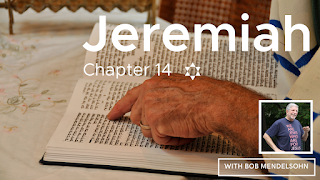
Drought then, storms today: Jeremiah chapter 14

 Truth and Consequences: 

A study in the prophecy of Jeremiah

Chapter 14


INTRODUCTION

And thank you friends for joining us today here in the Zoom room, as we unpack this painful and real story of Jeremiah 14. Let’s dig into it and find out what God has to say to us as 21st Century people wherever you live and for those on YouTube, from wherever and whenever you are watching. 

We are soaked here on the East Coast of Australia. Floods are abundant, even now, water is pouring into the Warragamba Dam and engineers are attempting to release enough to keep it healthy, but at the same time they are flooding downstream. Tens of thousands have been forced to evacuate their homes and businesses up and down the coast, from far south of Sydney all the way up to Brisbane. The once-in-a-100 year episode from either last year or 2011 has now been replaced by a once-in-a-500 year nomenclature. It’s like in the days of Noah, only we don’t yet have a boat.


            Contrast that with the scene in Jeremiah chapter 14. There we see verse after verse of devastation and loss, all caused by a drought. And we are going to hear cries of “woe is me” and “We have sinned” from the people to whom Jeremiah is preaching. And it seems that God, from heaven, says his phone line is busy or engaged. He seems reluctant to forgive us our sins. In fact, the phone line has been cut off entirely. What’s the deal with that?

            You might remember we spoke about this some weeks back. There are three audiences to whom Jeremiah is speaking. One, the people who actually heard him speak and cry out. They are the ones who will be going into captivity, whose life is characterised by the sins he has chronicled and listed over chapter after chapter. For them, it is too late. Prayer is of no consequence. The national problem of exile is in the cards and their weeping will not stop the just hands of the Almighty from the dispensed punishment. 


            That is not to say that any individual who cries out to the Lord won’t be heard. This fact is substantial that you understand this. The reality is exile; the individuals who are going to be led off into Babylon are EVERYone. But as Yeshua taught, the rain falls on the just and the unjust. We as a people were going to experience the penalty of our collective national sin. Individually, we had options to repent and to ‘give glory to God’ as we saw last week. 

            Think about it this way. Each of us has been under the blight of covid the last two years, but by mitigating it, by whatever methods we had to avoid or live through it, we have done so. Same with our floods just now. Some have died, but most have avoided the power and the tragedies associated with this flooding. The area is swamped. The bridges are out. The SES crews are working tirelessly. Reality is soaked. BUT you can stay a bit higher and drier individually. Games are washed out. Maybe even the Mardi Gras parade will be awash. But individuals can be safe and sound. See how that works?


            So it is with this notion of justice and punishment. The people to whom Jeremiah is speaking have a choice. Each person has a choice. The choice is not whether to go into exile. That’s settled. The choice is what kind of person I will be today and tomorrow. The choice is how I will respond to God’s justice meted to us as a people. 


            Think of the folks in Ukraine. They are under severe assault by a madman named Putin. The people of the armies of Russia, nearly 200,000 from the Belarus border around to the Crimean peninsula, are all not of one mind. Many soldiers are not happy about attacking their neighbours. Even so, they are doing so, relentlessly. And the people of Ukraine, upwards of 1 million so far in less than 10 days, have fled the country. Last year, they didn’t plan to leave home. But they have done so. The situation defines their life. BUT, and here’s the key, what they do with their life in the midst of the situation is what really defines THEM. We are individuals in the midst of society. What will the Ukrainians do in Romania or Poland? What kind of people will they be back who remain back in Kyiv, Odessa or Kharkov? 


            I said Jeremiah is writing for three sets of people. First is the people of his day. 

            The second group is the people of the exile who will be given the choice and the chance in 70 years to return to the Land and to live right. Knowing the consequences of wrong living, what choices will the people in two generations make while living displaced? The prophecy of Jeremiah is for them, so that they will make good choices and listen to the Word of the Lord. It’s given to encourage faithful leaders, shepherds and prophets, who will stand up among them and teach well. God’s word to them will be a warning mixed with the reality of their recent history and their own geography, and as such will be powerful.


            The third group to whom Jeremiah is writing is us. That is, people who are around on the planet long-since the season of life he foresaw. We who have the advice of this Book of Life can also make choices. We, too, can practice what he preached or we can enjoy the dainties of this life and fall to the same judgment Jeremiah predicted. God, in his mercy, gives us hope.  


            In the next section of the prophecy from chapters 14 to 17, Jeremiah delivers four different sermons or messages and drops into the writing the prayers he associates with them. They are his prayers. They show the depth of the prophet himself. God also will answer his prayers in this section. You should know chapter 17 may well be my favourite chapter in this whole book. And we will get there, Lord willing, in a few weeks.

            With all that as backdrop, let’s dig into the text.


Sermon One: Chapter 14: The first message concerns the Drought


1.     The plight of the land (.1-6)

Nothing escapes the effects of a drought. Remember, folks in the US have rivers and so do the Europeans and the Nile runs powerfully through Egypt, but the Jordan River is hardly enough to irrigate the country of Judah. The people depended on rain to provide needed agricultural assistance. Not too much, as we are experiencing just now in Australia, but enough. And there was NONE, so Jeremiah uses that information to teach the people of God’s ways. 


            As a result of drought, the land was suffering, and thus everyone suffered with it.  Four times in these opening verses emptiness and such is mentioned. Verse 3 “no water”, verse 4 “no rain”, verse 5 “no grass” and verse six “no vegetation.” It’s batting 0 for 4, and that’s a picture of emptiness. Hopelessness. The big goose egg on the scoreboard. 


            Look at the progression. Verse 3 it starts with the nobility, the wealthy sending their servants to the grocery store for the provision and they only find empty shelves. The farmer is equally devoid of hope and provision, and even the animals of the fields are penalized for the sins of Judah. Nothing and no one is exempt. The land is experiencing the plight of loss. 

            The image of a funeral is in both verses 3 and 4 with covered heads, humiliation and shame. 


2.     From plight to plea. (.7-9)

            Yes, things seem hopeless, but Jeremiah knows that he too has a responsibility in the matter. He is after all, the son of a priest. He is the weeping prophet. He has to proclaim God’s truth, no matter the cost. And now the cost includes his own participation in the people’s situation. NOT in the people’s sins. But in their punishment and their plight. 


            Hear verses 7 and 8 as the prayer we all can pray just now. We all can join in one voice to the Lord with “

“Although our iniquities testify against us, 

            O LORD, act for Your name’s sake! 

            Truly our apostasies have been many, 

            We have sinned against You.

8           “O Hope of Israel, 

            Its Savior in time of distress, 

            Why are You like a stranger in the land”


            Jeremiah changes from 2nd person to 1st person. It’s not “YOU GUYS SIN” but “we have sinned.” Like Daniel and Isaiah, like Moses and Paul, and most notably like Yeshua himself, we find a man who identifies with his people and cries out on behalf of them, including himself. Our iniquities in verse 7. Our apostasies. We have sinned. Can you say that today? Can you identify with our people in that way? Or are you an outsider, saying “THEM” and “they deserve your just punishment?” The cries of a prophet, and dare I say, of an evangelist, ought to come from the inside, not from a distance. 


            What does Jeremiah call him? Saviour, Hope, Stranger. What? Yes, he’s inviting God back into the conversation. He’s crying out and pleading with the Lord to rejoin. You have been on vacation, far away, a stranger, but now come, take up your holy throne. We invite you not only into the conversation but as the ruler of our lives.


            Jeremiah even invokes the old “we represent” and thus "if you shame us, it’s going to reflect poorly on you" device. But God won’t fall for that one. God has already said he’s going to wear us and what we do DOES reflect on him. But as often is the case, we see only the immediate and not the big picture. God’s justice is only the penultimate issue. His plan is to have mercy and to restore. But not just yet. We want niceties and kindness and we want it without cost or pain and we want it now. God, let’s just say, has other plans.


3.     God’s answer to the plea (.10-12)

            It may surprise you to learn that God isn’t always interested in our prayers. In fact, this is now the 3rd time in this prophecy that God tells Jeremiah to stop praying for the people. (7.16, 11.14) When he’s done, he’s done and there’s nothing you can do about it. Look at his pronouncement in verse 12. I’m not going to accept them; I am going to make an end of them by the sword, famine and pestilence. 


            Jeremiah told God he seemed like an alien, a stranger, but God answers that they were wandering (.10, also 2.17-19, 2.23-25, 2.31). The judgment is clear. It’s comprehensive. The exile is coming. 


4.     Jeremiah makes a protest appeal (.13-16)

            God won’t hear of it, though. Jeremiah says it’s the false prophets who are leading the people astray. And God agrees, but still, the people are responsible for whom they follow. (Deut. 13, Deut 18). 


5.     The pain and prayer of agreement with God (.17-22)

            Finally, God gets through to Jeremiah that his rule is going to prevail and the people are going into exile. And as before, and as Ezra and Nehemiah and so many others, the language shifts from ‘they’ to ‘we’ and Jeremiah takes the role of intercessor.  We have sinned. God have mercy. And listen to the final words in verse 22.       

“Are there any among the idols of the nations who give rain? 


            Or can the heavens grant showers? 

            Is it not You, O LORD our God? 

            Therefore we hope in You, 

            For You are the one who has done all these things.”

            God is the one on whom we can rely. And he alone. He alone can forgive and cause rain. Jeremiah takes on himself the sins of the people, in a way, and points us to the Eternal One. 


Yeshua, of course, is the most notable of the prophets who takes the sins of the people on himself. At the end of his public ministry, from the cross, Yeshua cries, “Father, forgive them, they don’t know what they are doing.” His atoning work, his death as a sacrifice, as a substitute for the sins of the Jewish people, and really all people, is the greatest love gift ever extended to humanity. If you are new to this study, if you are new to the questions of faith and God himself, keep your eyes on Yeshua, the author and finisher of all things faith, and he will bring you to himself, to eternity, to confidence and to forgiveness for all your sins. What a Hope for Israel. What a Saviour of the world!


CONCLUSION

God is calling each of us to know him and to walk with him, today and throughout our days. Have you received Yeshua as your messiah and Lord? Have you renounced your sin, your idolatry, your forsaking God and given him First Place in your life? If not, please, do so now, just now, as we pray together. Use your own words, if you want, but yield, surrender, to the Lord of life. 


PRAYER


Then please write us (admin@jewsforjesus.org.au) to tell us what you have just done, and we will send you literature and encourage you. You are part of our family; we love and appreciate you. And we want you to enjoy the presence of the Lord who calls, who knows, who blesses and builds us up. 

We hope to see you again next week as we study chapter 13. Until then, Shabbat shalom!


BIBLIOGRAPHY

Barnes, Albert, Albert Barnes’ Commentary on the Old Testament, 

Craigie, Peter; Kelley, Page; Drinkard, Joel. Word Biblical Commentary. Book of Jeremiah.  1991. 

Henry, Matthew, Commentary.

Weirsbe, Warren. Be Decisive. David Cook Publishers, Colorado Springs 1991.

Wright, Christopher, The Message of Jeremiah, The Bible Speaks Today, Intervarsity Press, Downers Grove, Illinois, 2014.

For other links:

FB: https://www.facebook.com/jewsforjesusau

The videos, especially the Bible teachings are always free. However, if you are enjoying and learning from them, and would like to share in the costs $ of putting them together, to donate use this link:  https://www.jewsforjesus.org.au/giving 

T: http://www.twitter.com/jewsforjesusau

I: https://www.instagram.com/jewsforjesusau

If you haven’t yet done so, please click the red box to the right which says ‘SUBSCRIBE’ and you will be notified of any new content on our channel. Thanks!


ACTUAL TEXT

Jer. 14:1   That which came as the word of the LORD to Jeremiah in regard to the drought:

2           “Judah mourns 

            And her gates languish; 

            They sit on the ground in mourning, 

            And the cry of Jerusalem has ascended.

3           “Their nobles have sent their servants for water; 

            They have come to the cisterns and found no water. 

            They have returned with their vessels empty; 

            They have been put to shame and humiliated, 

            And they cover their heads.

4           “Because the ground is cracked, 

            For there has been no rain on the land; 

            The farmers have been put to shame, 

            They have covered their heads.

5           “For even the doe in the field has given birth only to abandon her young, 

            Because there is no grass.

6           “The wild donkeys stand on the bare heights; 

            They pant for air like jackals, 

            Their eyes fail 

            For there is no vegetation.

7           “Although our iniquities testify against us, 

            O LORD, act for Your name’s sake! 

            Truly our apostasies have been many, 

            We have sinned against You.

8           “O Hope of Israel, 

            Its Savior in time of distress, 

            Why are You like a stranger in the land 

            Or like a traveller who has pitched his tent for the night?

9           “Why are You like a man dismayed, 

            Like a mighty man who cannot save? 

            Yet You are in our midst, O LORD, 

            And we are called by Your name; 

            Do not forsake us!”


Jer. 14:10   Thus says the LORD to this people, “Even so they have loved to wander; they have not kept their feet in check. Therefore the LORD does not accept them; now He will remember their iniquity and call their sins to account.” 11 So the LORD said to me, “Do not pray for the welfare of this people. 12 “When they fast, I am not going to listen to their cry; and when they offer burnt offering and grain offering, I am not going to accept them. Rather I am going to make an end of them by the sword, famine and pestilence.”


Jer. 14:13   But, “Ah, Lord GOD!” I said, “Look, the prophets are telling them, ‘You will not see the sword nor will you have famine, but I will give you lasting peace in this place.’” 14 Then the LORD said to me, “The prophets are prophesying falsehood in My name. I have neither sent them nor commanded them nor spoken to them; they are prophesying to you a false vision, divination, futility and the deception of their own minds. 15 “Therefore thus says the LORD concerning the prophets who are prophesying in My name, although it was not I who sent them — yet they keep saying, ‘There will be no sword or famine in this land’ — by sword and famine those prophets shall meet their end! 16 “The people also to whom they are prophesying will be thrown out into the streets of Jerusalem because of the famine and the sword; and there will be no one to bury them — neither them, nor their wives, nor their sons, nor their daughters — for I will pour out their own wickedness on them.

17         “You will say this word to them, 

            ‘Let my eyes flow down with tears night and day, 

            And let them not cease; 

            For the virgin daughter of my people has been crushed with a mighty blow, 

            With a sorely infected wound.

18         ‘If I go out to the country, 

            Behold, those slain with the sword! 

            Or if I enter the city, 

            Behold, diseases of famine! 

            For both prophet and priest 

            Have gone roving about in the land that they do not know.’”


Jer. 14:19        Have You completely rejected Judah? 

            Or have You loathed Zion? 

            Why have You stricken us so that we are beyond healing? 

            We waited for peace, but nothing good came; 

            And for a time of healing, but behold, terror!

20         We know our wickedness, O LORD, 

            The iniquity of our fathers, for we have sinned against You.

21         Do not despise us, for Your own name’s sake; 

            Do not disgrace the throne of Your glory; 

            Remember and do not annul Your covenant with us.

22         Are there any among the idols of the nations who give rain? 

            Or can the heavens grant showers? 

            Is it not You, O LORD our God? 

            Therefore we hope in You, 

            For You are the one who has done all these things.

Where were you on...?

Today in history is 7 October. Perhaps you remember attending a friend's birthday party or watching a game of the World Series. For some...